


This week The New York Times’ DealBook had a column on the ongoing love triangle between law firms, their clients, and AI. In short, law firms want to claim AI is just a work friend and clients are asking to see the receipts.
The article is punctuated by quotes from big-time firms, AI developers, and industry adjuncts. One consultant describes client attitudes as:
I want a discount on this….We know you have this new A.I. tool in house because we saw your splashy press release.
—Jennifer Leonard, Founder, Creative Lawyer
The piece ends with a quote from an AI developer:
Nobody wants to be the first firm who really leads the way and goes out there.
They’re trying to prepare for the day where they do need to start to pivot. And they want to be prepared.
—Kyle Poe, Vice President, Legora
Back in June Josh Barro and Ken White (Serious Trouble podcast) dug into this as well.
Naturally I needed to model these dynamics to go beyond vibey predictions about law firm use of AI, and how it shows up in the client invoice.
Formal Model
A law firm sells many kinds of legal tasks. AI cuts the hours required to complete some of those tasks. The model asks two things:
when does AI adoption for a given task raise the firm’s profit?
when does billing for that task move from hourly to fixed fees?
Parameters
h - expected hours to completion, w/o AI
a - share of hours to completion remaining, w/ AI (ex: a = x means AI shaves the share 1-x; 0 < a < 1)
σ2 - variance in hours to completion (uncertainty)
v - value to client
z - client’s outside price (ex: going to another firm; in-house; the effective “market price”) (z = rh, pre-AI; z = rha, full AI adoption)
ε - client elasticity of demand in price (0 = must-have work; above 1 = highly discretionary)
r - firm avg. billing rate/hour
c - firm avg. cost/hour
ρ - firm risk aversion w.r.t. fixed-fee work
m - degree to which the market price z reflects AI-induced savings
Everything is applied as to a given task.
Assumptions
Partial equilibrium: r, c, z exogenous.
Mean–variance preferences, with the risk term attaching only to potential costs which cannot be offloaded.
AI scales both mean and the spread of hours by a.
Firm has slack capacity, except where noted.
With increasing AI adoption, z → rha. So m is the degree to which the market price reflects the AI adoption-induced savings:
When m = 0, no firms have adopted AI-assistance and therefore no realized productivity gains/cost savings; m = 1, full adoption and market price reflects that.
Contracting.
The firm chooses:
(i) whether to use AI, and
(ii) hourly vs. fixed billing,
then offers a price. The client accepts anything at or below min{v, z}.
For must-have work, v is large, so z is the binding constraint.
Hourly billing: the client pays for realized hours; the firm bears no cost overrun risk.
Fixed fee billing: the law firm benefits from realized savings as well as bears risk of cost overrun.
Payoffs
The firm has four options:
Hourly, no AI
Hourly, with AI
Fixed fee, no AI
Fixed fee, with AI
Results
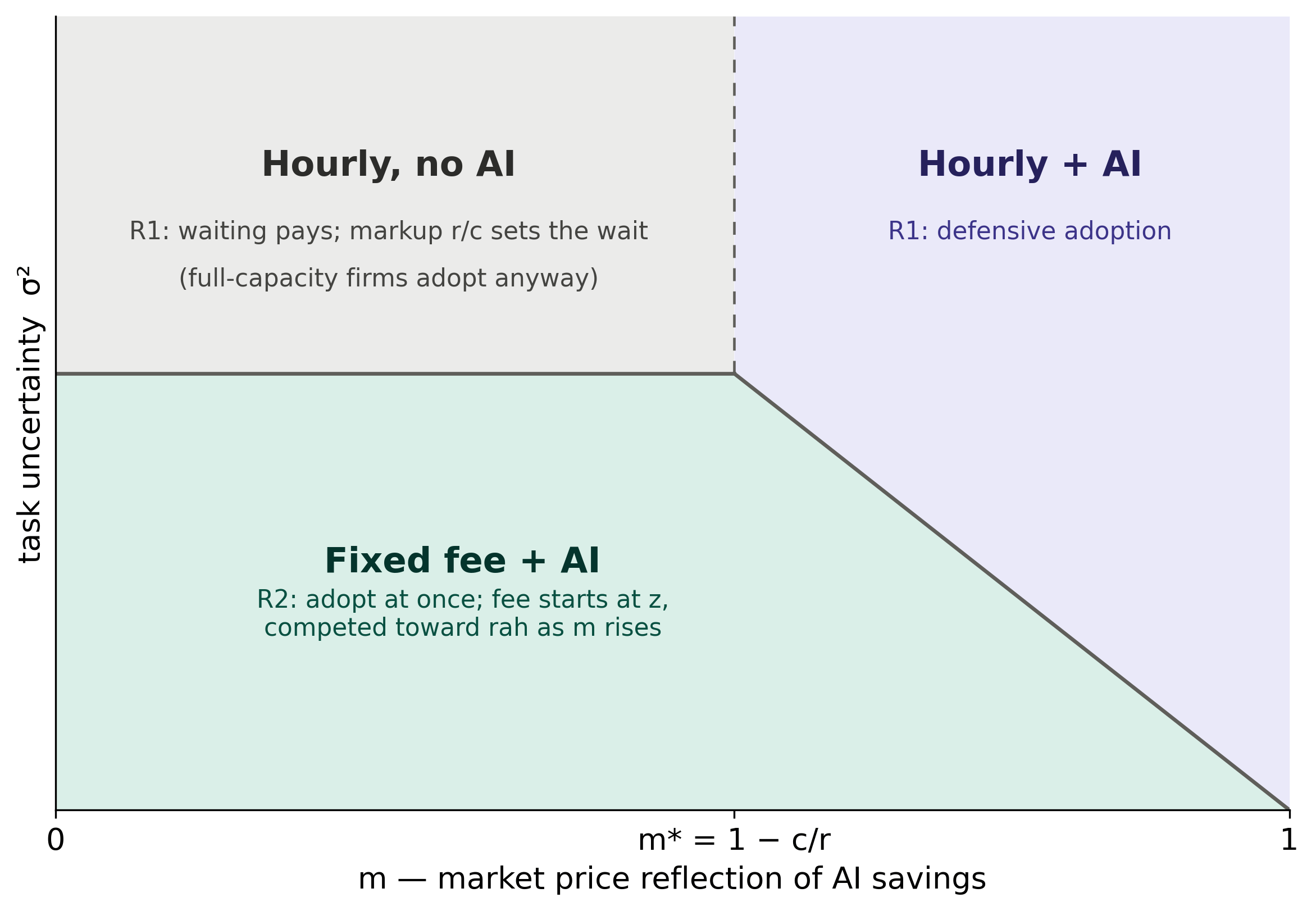
Law firm chooses among the four billing/production structures to maximize payoff. Each one occurs under various conditions. Which one the firm chooses depends on σ2 and m.
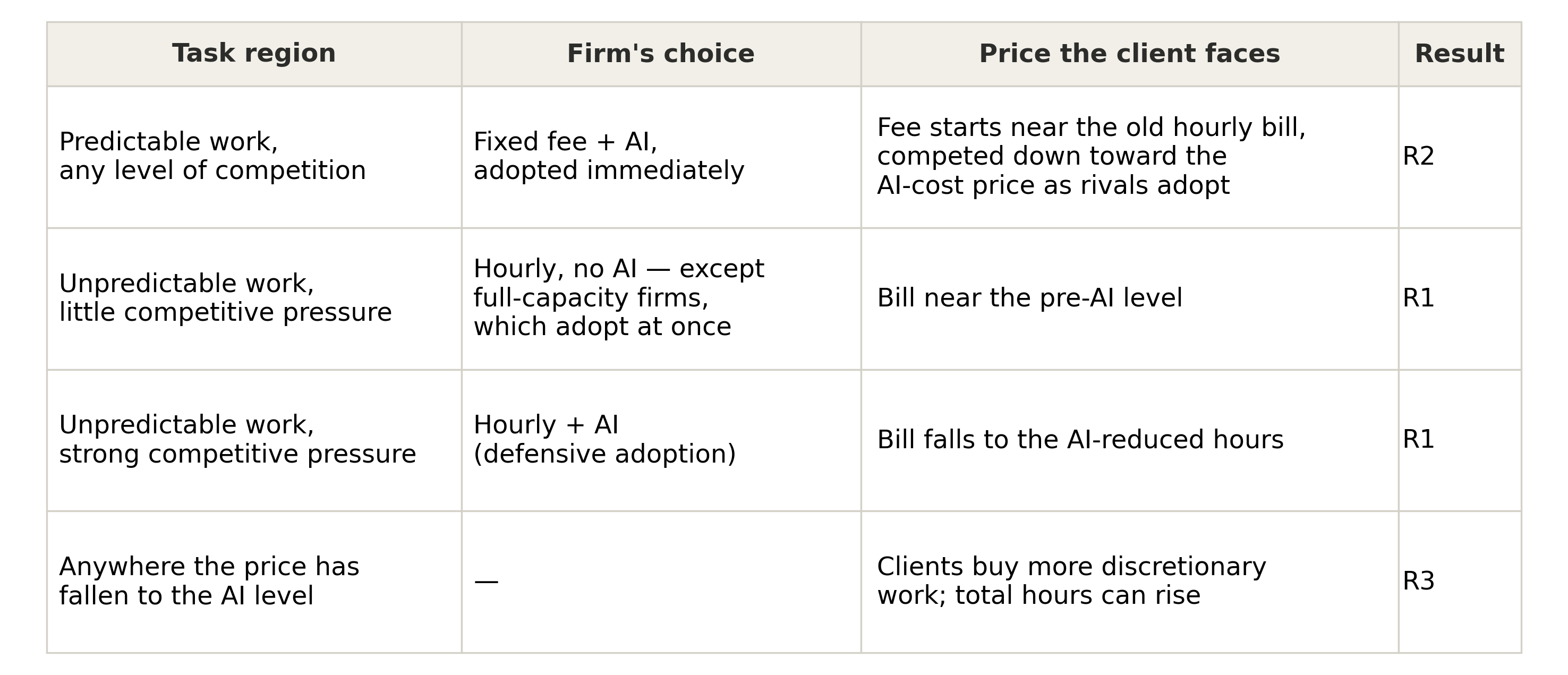
Result 1. Unpredictable work is billed hourly.
Above a certain threshold of risk - that the task might require more work than anticipated - the firm chooses to bill hourly regardless of level of m (level of AI adoption).
Under hourly billing, adopting AI and therefore saving hours doesn’t a priori benefit the firm. Firms with the highest markup (r/c) benefit from waiting the longest for these tasks. Lower markup firms will adopt sooner as the market price (z) decreases to reflect competitive savings from AI adoption.
Exception: Firms at full capacity essentially have nothing to lose, in that saved hours (even hourly billed) in one task frees up billable hours elsewhere they weren’t able to do before, so they’ll adopt AI as soon as possible.
Result 2. Predictable work is billed as fixed-fee and encourages early AI adoption
Below the risk threshold, the firm benefits by adopting AI and capturing the savings. Those savings are largest when the industry is earliest in the adoption cycle, and get competed away as the industry adopts AI and the competitive price moves towards fully reflecting the savings.
Result 3. Client demand increases as a price-response
As the market price moves to reflect increased AI-induced productivity gains, demand for discretionary tasks (i.e., those with the highest price-elasticity) increases.
Results (Graphical Summary)
The author is nonresident senior fellow at FAI