

Reporters and quasi-pseudo journalists have now adopted the “Why Data Centers are the THE Issue of the Midterms” prompt as starting point for fashionable trend pieces.
And they’re not wrong. A friend of mine who directs tens-of-millions of dollars in midterm election spending says he’s never seen voter salience of an issue increase so quickly, of AI that is.
Arvind Narayanan recently claimed that a data center moratorium would slow AI development basically not at all (he of AI Snake Oil fame).
Understandably some people took notice, because everybody feels some kinda way about data centers lately.
He uses a back-of-the-envelope calculation, using “leakage” from a moratorium to determine that such a policy would only very marginally effect “AI progress.”
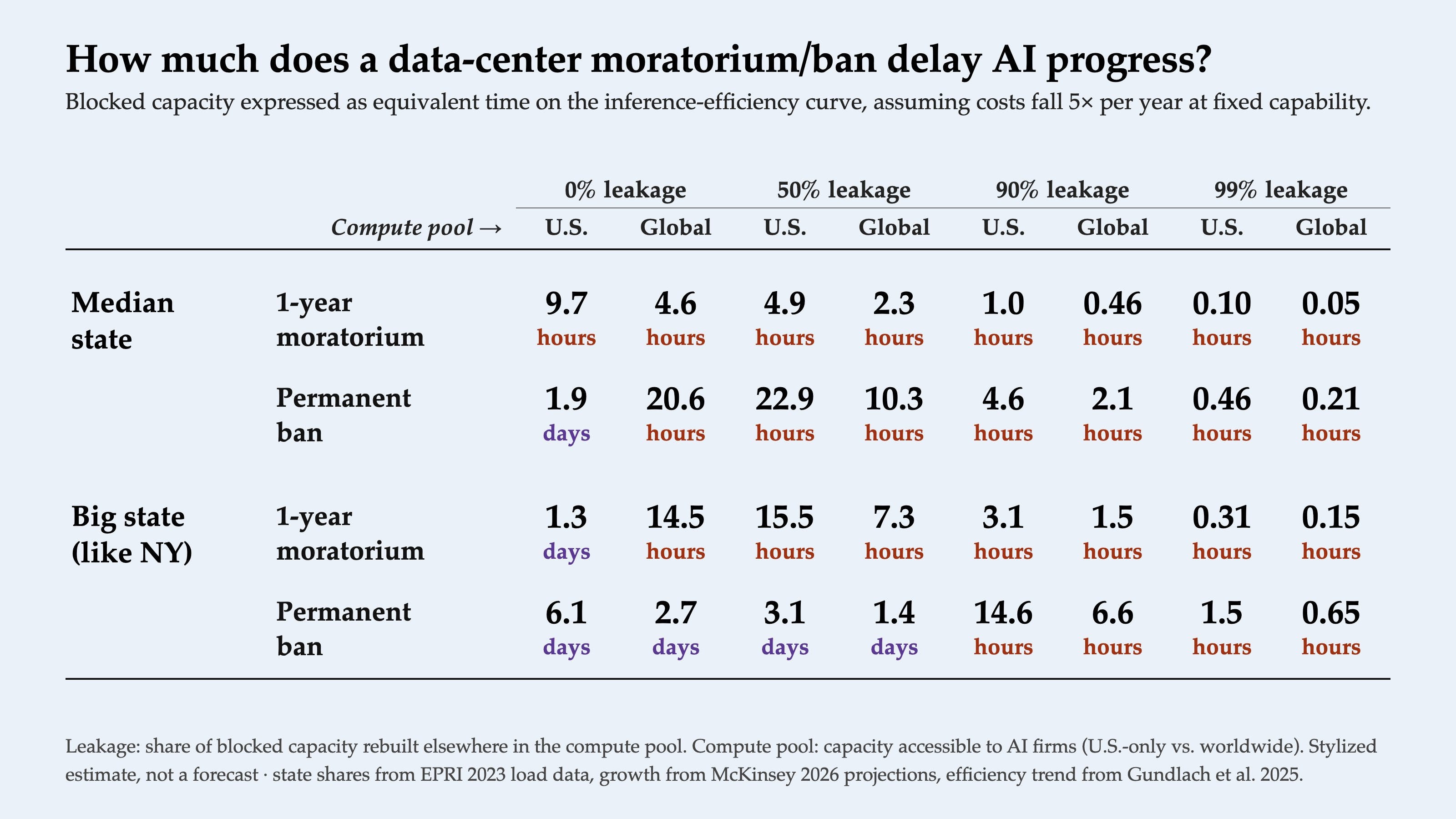
Below I run with Narayanan’s question, and model it.
I don’t argue otherwise, but rather want to see why this is the case via a structural model, using more severe, absolute policy regimes to keep the results clean. The point isn’t that these are realistic conditions as stated, but they allow us to determine boundaries (directionally) for policy choices, within which we know more real-world policies inhabit.
It’s not a test of Narayanan’s claims per se, but another way to get at the same question, and one that can be easily modified to account for different or more granular data, as it is a structural model.1
The Premise
We measure data centers in “megawatts” (MWs) — it’s just the most useful unit of measurement. Of course most of the public that cares about this stuff only care about it in binary “0 and 1” terms, as in, Is that new construction in my neighborhood happening or not? But building a data center or not is ultimately about increasing power capacity routed to AI compute.
The implied setup is this:
Power = Compute (A data center is access to power)
a. Compute → AI capability (AI capability increases in compute availability)
b. Efficiency → AI capability (The software itself improves, substituting for compute; better algorithms do more with less)
Time → Efficiency (he assumes the compute needed to accomplish a given AI capability decreases to one-fifth every year)
Therefore: Compute ∝ Time
So what a data center moratorium does can be measured in terms of time: 5-10 hours is the amount a one-year moratorium slows down AI capability according to Narayanan.
The Question
Under what conditions does “AI advancement” occur or stop, determined as a path of progress?
Narrative Model
Narayanan applies a given efficiency improvement rate in AI development to see what happens: efficiency improves at a rate of 5x/year. Instead I assume efficiency is endogenous, with increases in model efficiency occurring at the training stage, at the expense of inference compute. That is, based on Gundlach et al. (2025a and 2025b),2 AI model efficiency improvements (including via distillation) is done by the lab/developers before deployment, but revenue occurs after deployment.
So there’s something of a tradeoff that keeps frontier development from devoting 100% capacity to model improvement. Behaviorally, this split is also a function of a power capacity footprint viewed as bounded or not. Further it reflects current practice (to the degree we know such things).
The result: only under an extremely draconian data center moratorium would AI advancement meaningfully slow or stop. Under a more realistic moratorium condition, advancement is delayed to some degree but never fully slowed relative to a full laissez faire condition.
Formal Model
Algorithmic efficiency grows when compute is spent on improving it. Because efficiency research consumes compute, the size of the compute stock sets how fast efficiency accumulates.
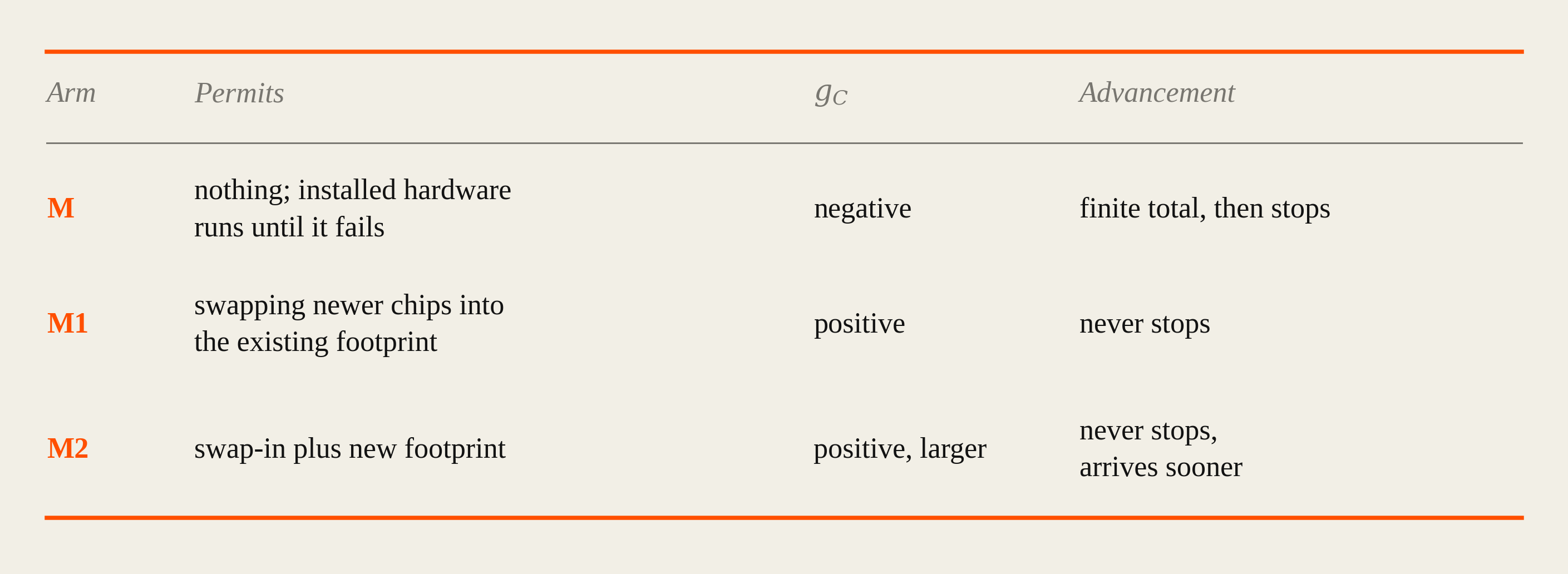
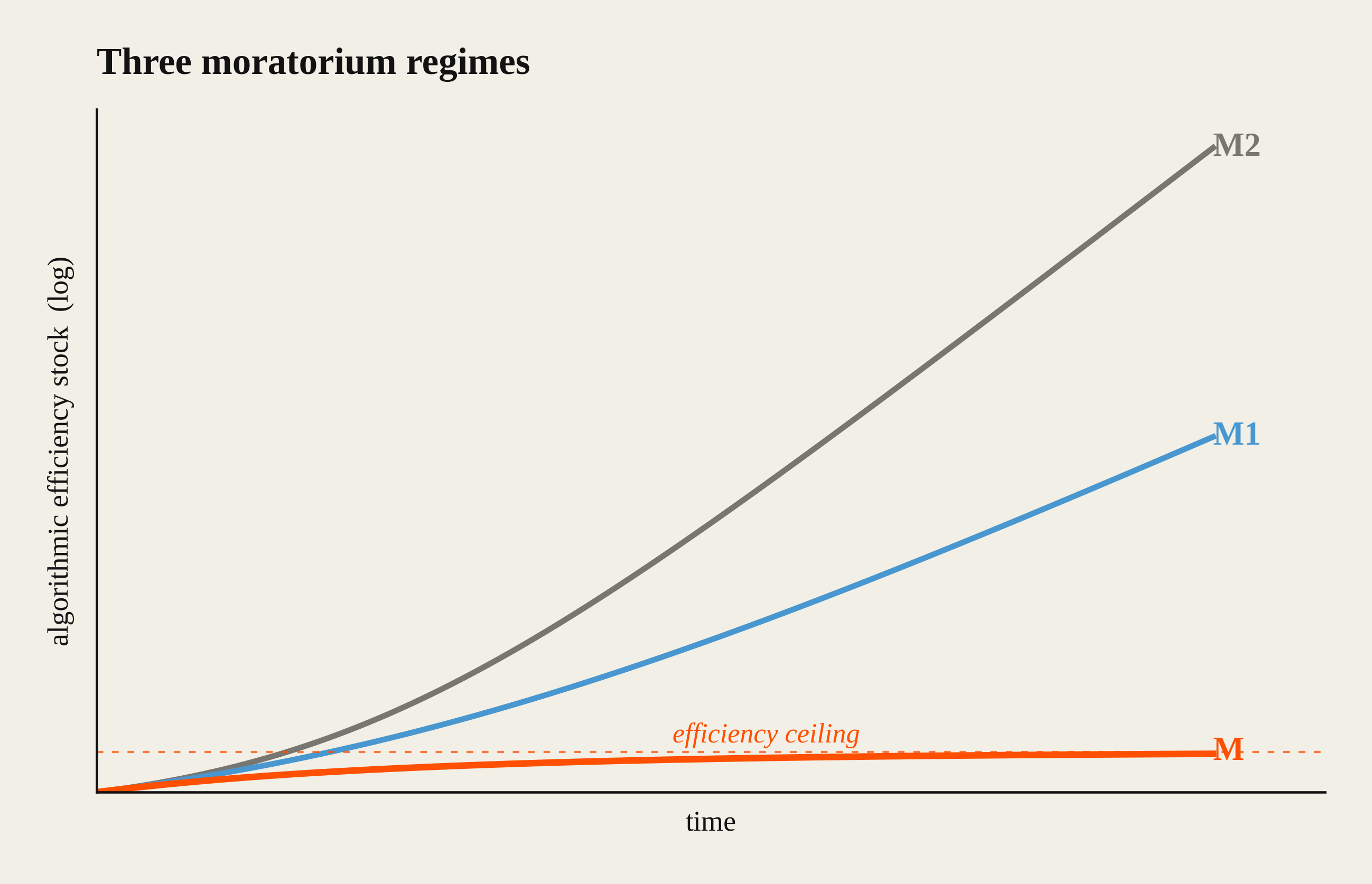
Three policy conditions: (M) compute stock shrinks in absolute terms, (M1) compute grows through hardware replacement, or (M2) grows through replacement plus new construction.
Parameters
At - algorithmic efficiency stock, the compute saved in reaching a fixed capability level
Ct - physical compute stock
gC - growth rate of the compute stock (gC = gP + gW)
gW - growth rate of performance per watt
gP - growth rate of the power envelope through new construction (gP = 0 under M and M1)
δ - hardware depreciation rate
θt - the allocation of compute to research phase vs. deployment phase
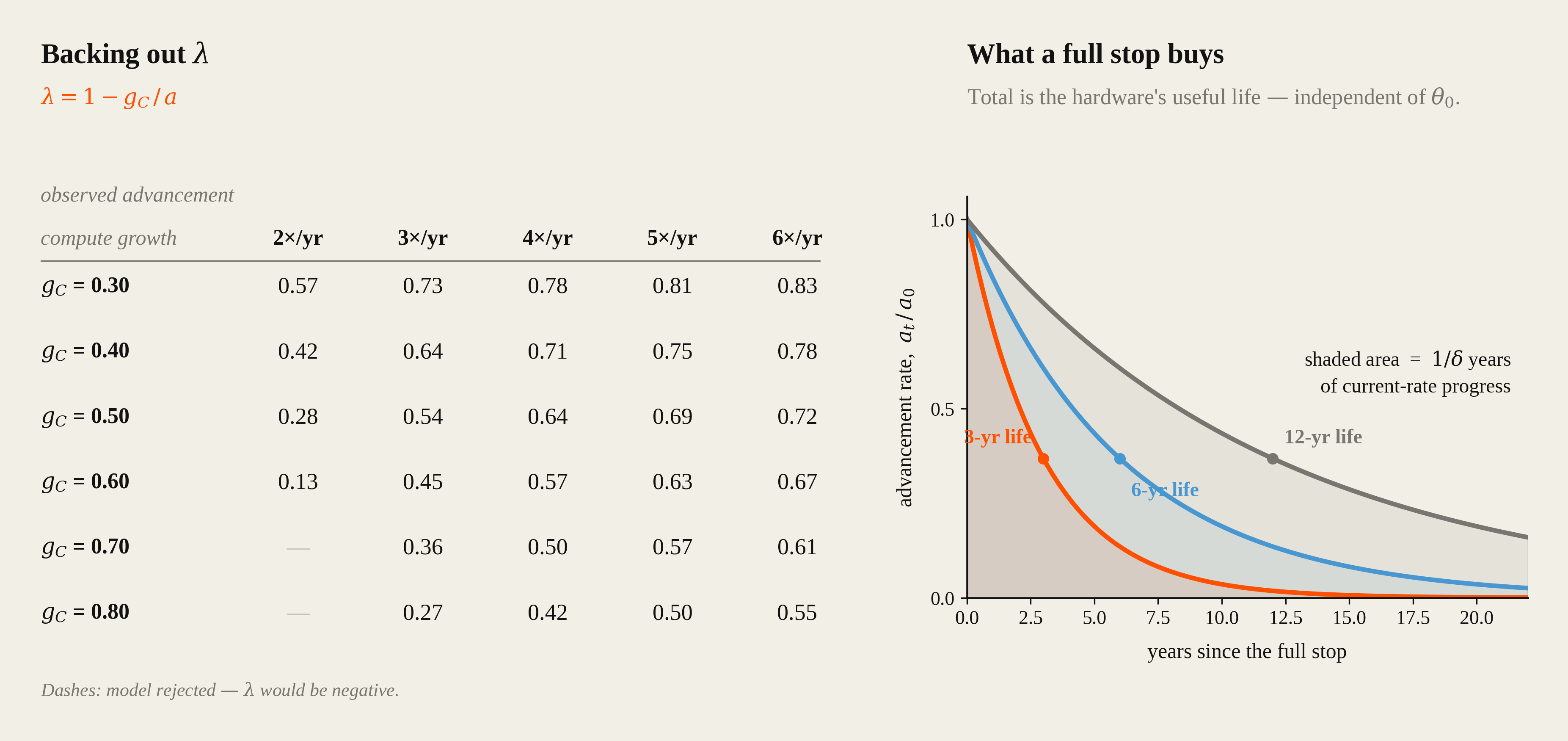
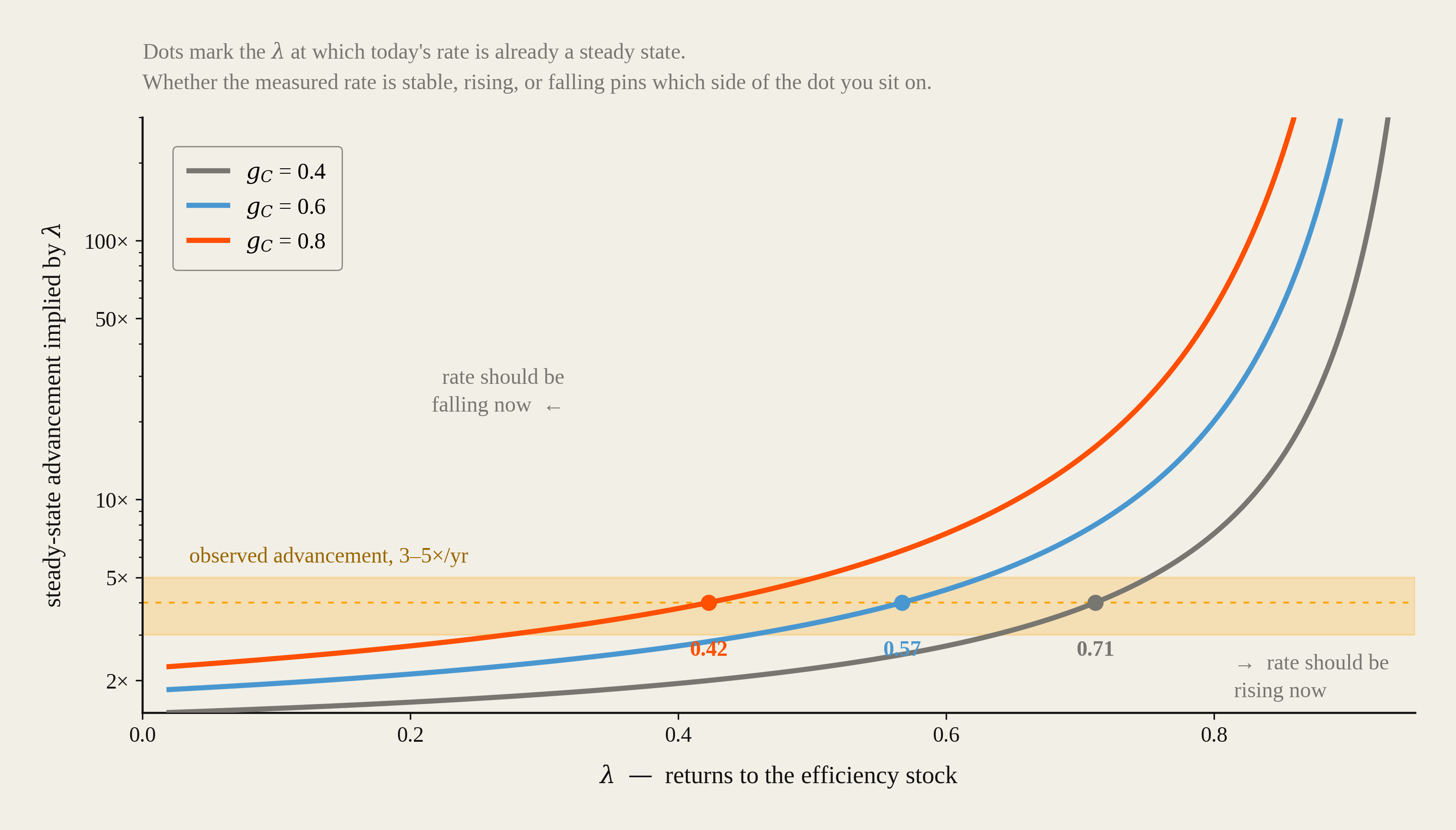
λ - returns to the efficiency stock in producing further efficiency; non-explosive condition, λ ≤ 1.
at - advancement, defined as the proportional rate at which the compute required to reach a fixed capability level falls
Efficiency gains are produced at the development stage and consume compute, so research productivity depends on the size of the compute stock, taken linear in it.
Results
Under M, no new data centers are built and depreciating hardware is not replaced.
The stock shrinks at the depreciation rate.
Efficiency grows through research productivity acting on the efficiency stock, with productivity tracking the compute stock.
Research productivity scales with available compute and accumulated efficiency stock.
Under M the first factor decays to zero, so efficiency approaches a ceiling and advancement stops. At λ = 1 the total is finite:
Under M1, newer chips swap into the existing footprint. Construction stays barred, so gP = 0, but replacement offsets depreciation and captures each generation's gain in performance per watt.
M2 permits construction alongside replacement, at a rate below unconstrained buildout, so both margins are live.
Both treatments put the compute stock on a growing path; they differ only in how fast.
With gC > 0 the decaying factor becomes a growing one, the integral diverges, and advancement never stops.
Conclusion
Taken from two different directions, we can confidently draw the conclusion that any reasonably available form of moratorium will not stop or significantly slow “AI advancement.” If that is your goal, you’d need to find a different policy lever to pull.
But as I think most of us have realized, the data center protest, the political bandwagon-ing, etc. are all proxies for a wider and less-defined voter anxiety. And as I’ve mentioned in fairly direct and impolite terms elsewhere, being right isn’t the same thing as being on the right side (in a democracy, at least).
So accelerationists can take a smug comfort in the fact that data center construction is not a binding constraint on AI development, but this voter energy won’t likely stay put at this one proxy. Who’s to say to say the next one won’t be fatal.
The author is nonresident senior fellow at FAI
Appendix
For example, an extension would endogenize the compute split between training and inference. Kind of like an intertemporal Euler condition.
Hans Gundlach et al., “Price of Progress,” arXiv:2511.23455. https://arxiv.org/abs/2511.23455 (2025a); Hans Gundlach et al., “On the origin of algorithmic progress in AI,” arXiv:2511.21622. https://arxiv.org/abs/2511.21622 (2025b).