


Setting the Agenda
This article builds on an earlier model of intra-caucus Congressional bargaining.

In short, it's a game theory model between “Leadership” trying to pass a bill and a “Faction” trying to extract concessions. The members in the faction are not fixed and can change with the particulars of each bill. It describes a scenario where the majority has a slim margin over the minority, consistent with the last couple Congresses (and specifically the House given the distinct procedural architecture of the Senate).
It assumes the given bill over which negotiation is happening is exogenous. You can apply the particulars of the bill to predict thresholds and bargaining dynamics, but it leaves unexplored how leadership selects what bill to move, when.
So here we empirically test the shape of the agenda through what vehicles get negotiated over. Not by subject, but through choice of floor consideration mechanism: open v. closed rule and suspension.
The intuition is the following:
If there’s a slim-majority bargain to be had, it first gets leveraged in the form of a “rule” applying to the legislation. Leadership needs sufficient support for the rule structure if it is to move to final consideration. But that choice is endogenous.
Much of the literature describes Congressional leadership’s influence showing up through setting the agenda: deciding what makes it to the floor or not. For example Cox and McCubbins (Setting the Agenda: Responsible Party Government in the U.S. House of Representatives, 2005) argues the majority party’s core power is gating what reaches the floor, with choice of rule as the mechanism.
Below I offer some hypotheses and test them using data from the last three Congresses.
Stand Up and Be Counted
We can make some conclusions about the Leadership’s objective function by looking at closed-rules behavior. The three hypotheses and the test results:
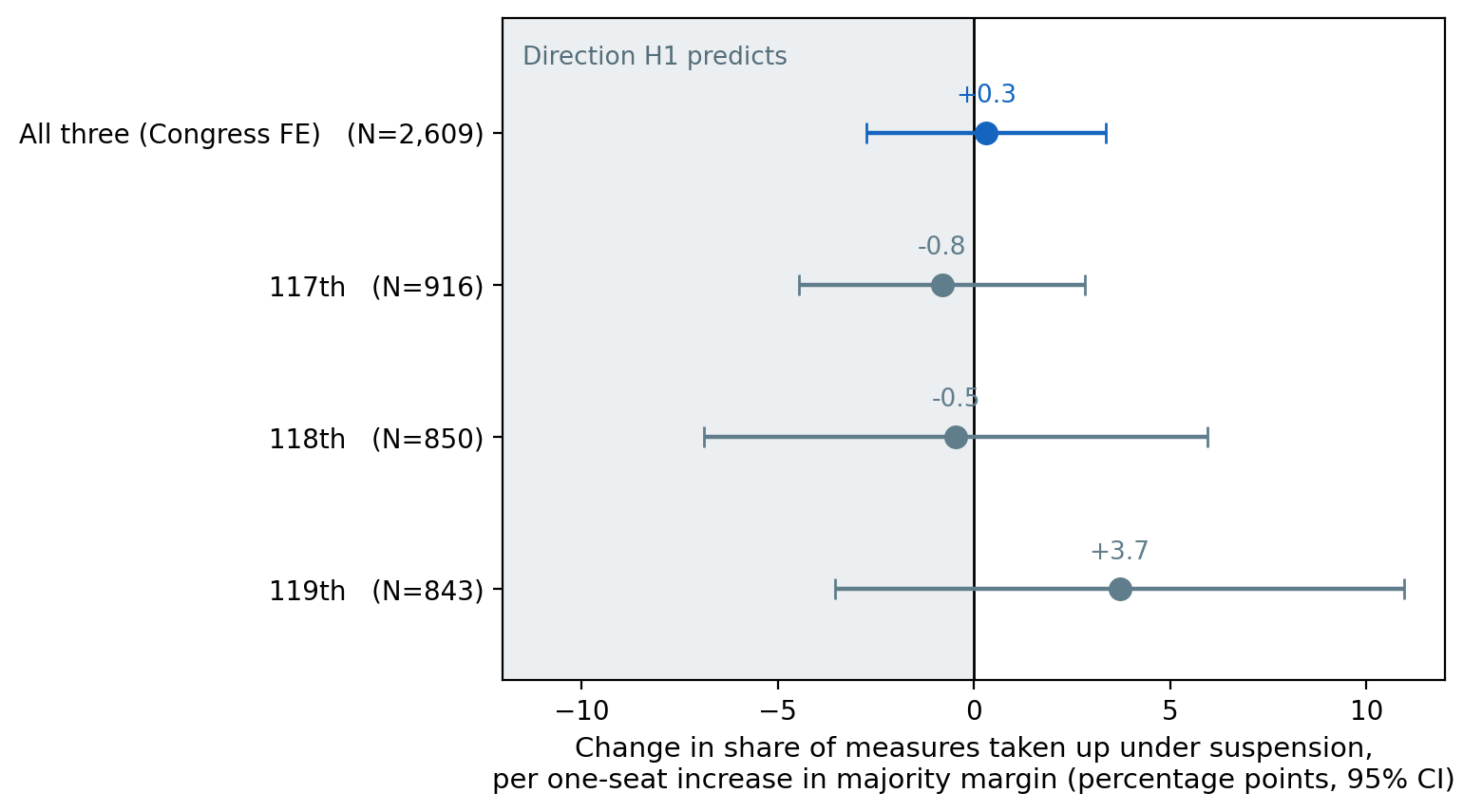
❌ H1: As majority margin ⬇️, share of suspensions ⬆️ (relative to special rules)
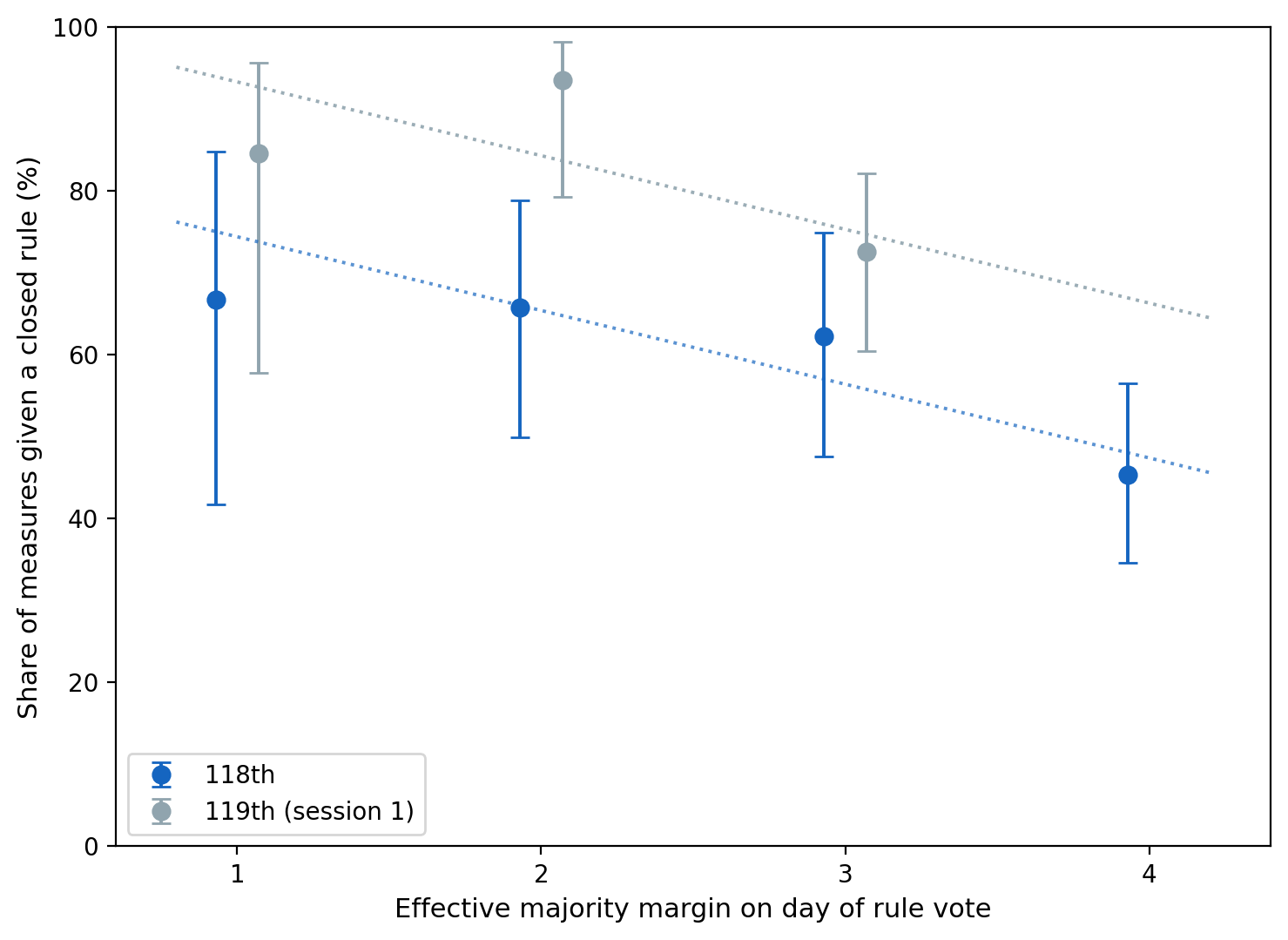
✅ H2: As majority margin ⬇️, likelihood of a closed rule ⬆️
🟡 H3: Leadership-backed rules fail consistently across majority margins
Hypothesis 1
Suspension is a mechanism that routes around a rule vote, at the price of needing two-thirds and therefore minority votes. So if a shrinking margin makes the rule vote riskier, the obvious adaptation is to go around it.
Ultimately, suspensions carry 70–85 percent of House-passed measures. The bills where holdouts actually have leverage are too few to move that share, so we can’t reject the null result that the share of suspension votes don’t follow the size of majority margin.
Claim: Share of Suspension Votes Goes Up as Margins Get Tighter
Verdict: Rejection
Hypothesis 2
Essentially the default should be a “closed rule” which puts forward a floor vote with no option for amending — take it or leave it. It limits an avenue of leverage for holdouts to threaten passage. However limiting or eliminating amendments also removes an avenue to negotiate for support. So there’s a tradeoff.
Claim: Likelihood of a Closed Rule Increases as Margins Get Slimmer
Verdict: Strong Support
Hypothesis 3
While rare, leadership can and does lose some rule votes but obviously wants to minimize that outcome ceteris paribus. Contested rule votes are a necessary option, and as a first-order effect the failure rate should increase as margins decrease and holdout leverage increases.
However there’s a compensating behavior. The number and scope of the agenda is not fixed, so the effective cost to leadership is the same across different margins. And therefore altogether (so this claim goes) they should lose rule votes at a consistent rate.
Claim: Leaderships Lose Rule Votes at the Same Rate
Verdict: Weak Support
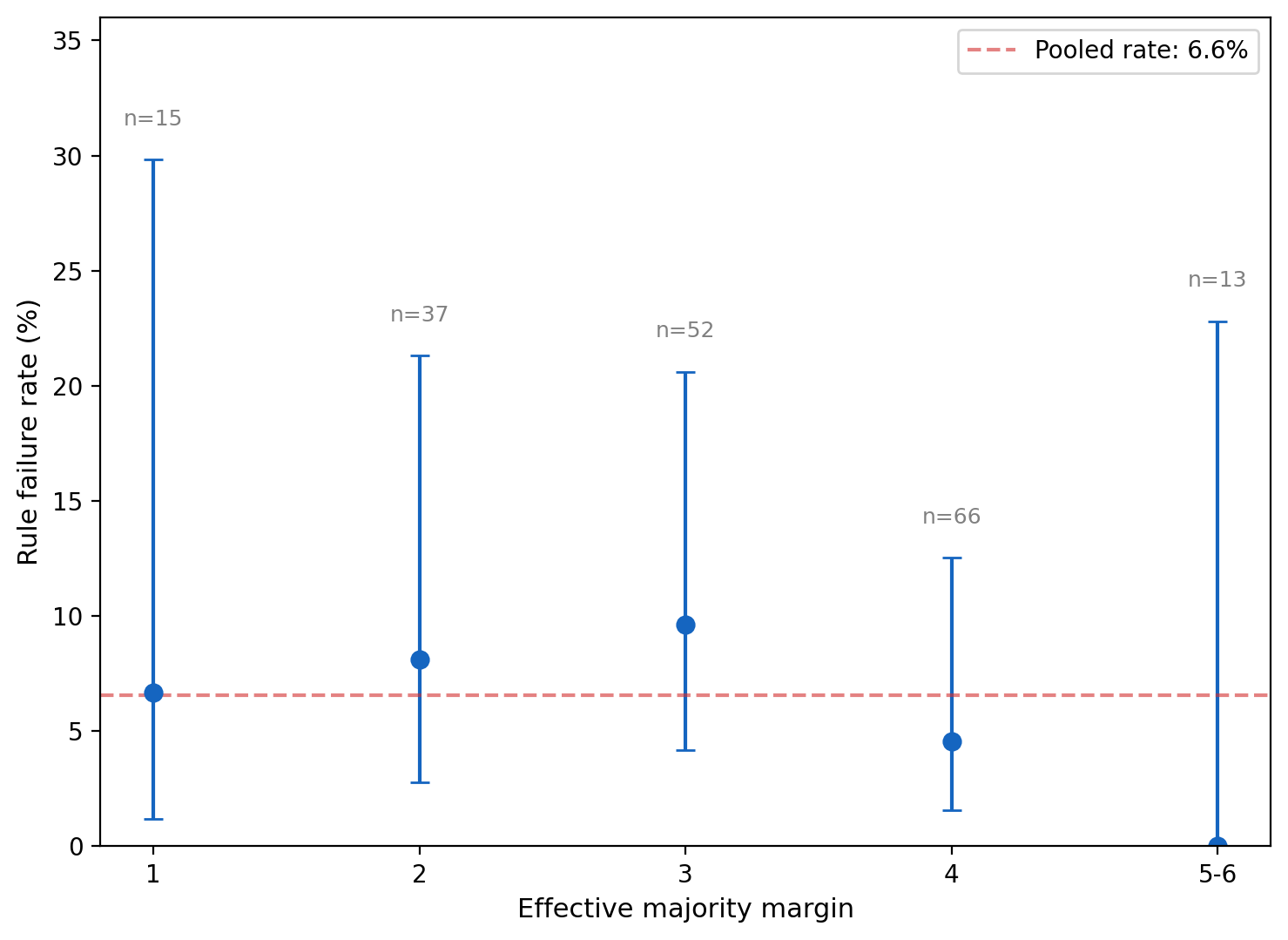
Technically we can’t reject the hypothesis but as you can see the standard errors are quite large. If we exclude the Pelosi portion of the sample we get a tighter confidence interval and a confident verdict that the hypothesis holds.
Note: From 2011-2022 rule votes were adopted 100 percent of the time (n = 519), so this is clearly a slim-majority phenomenon.
Note on data validation:
118th Congress closed-rule share: own reconstruction based on McGovern committee staff report criteria (56.1%) = Wolfensberger’s figure (56.1%), using different criteria which indicates the former is not the result of partisan bias in coding.
119th Congress, 1st session closed-rule share: own reconstruction (80.2%) (closed-rule list from McGovern committee staff report, Appendix D, matched against independent Voteview denominator through Dec. 29, 2025) ≈ the staff report's own "more than 4 out of 5 measures" ≈ McGovern's 83% figure (as of February 2026).
DATA SOURCES:
Ballotpedia, “Vacancies in the United States Congress” (117th and 118th Congress)
Jeffrey Lewis, et al., Voteview: Congressional Roll-Call Votes Database. https://voteview.com/ (2026)
Office of the Clerk, U.S. House of Representatives, “Vacancies.”
House Rules Committee Democratic Staff, "How Donald Trump Stole Congress" (Staff Report, Part I), Dec. 29, 2025 (“McGovern Report”)
Don Wolfensberger, "A Farewell to Open Rules," Dreier Roundtable (Claremont McKenna College), Feb. 12, 2026.
GPO, BILLSTATUS bulk data, 117th–119th Congresses (accessed Sept. 21, 2026)
CRS, Suspension of the Rules: House Practice in the 118th Congress, R48650 (Aug. 27, 2025)
The author is nonresident senior fellow at FAI