


A version of this essay first appeared in Notice & Comment (Yale Journal on Regulation) on September 19, 2026.
You Can’t Sit With Us
Chief Justice Roberts’s dissent in the so-called White House ballroom case1 turned some heads, for its positioning more than its actual position.
To wit, The New York Times characterizes him as being in unfamiliar minority (“On Trump’s Ballroom, Chief Justice Finds Himself in an Unusual Spot: In Dissent,” Sep. 1, 2026).
In short he argues construction violates 40 USC 8106 which reads in full:
A building or structure shall not be erected on any reservation, park, or public grounds of the Federal Government in the District of Columbia without express authority of Congress.
And even though Congress in fact appropriated approx. $2.5 million for maintenance purposes (3 USC 105(d)(1)) in 2026, Roberts says that ain’t it:
a couple million dollars for ordinary Executive Residence maintenance and repairs likely does not authorize the President to use hundreds of millions of dollars in private donations to tear down the East Wing and construct a ballroom in its stead.
Preach!
Therefore, according to his logic, the construction – and by extension the court’s majority – infringes Congress’s authority over federal buildings and its appropriations prerogative.
Notwithstanding his unfamiliar situating amongst the minority, the dissent is fairly straightforward and I find it’s reasoning mundane.
Where’s Congress?
What makes it curious, though, is that the essential party in the case, the one that is being infringed upon by his own framing, is not a party to the case. Roberts is quite concerned about Congress nonetheless.
Which is welcome news.
As I’ve written elsewhere, it’s something of a problem that the Article I branch seems to have the narrowest path to address harms to its Constitutional vestments via the courts, standards for standing being what they are.
Yet the opinion turns on a very specific nexus of harm. In order to vindicate an infringement against Congress he has to take a walk alongside a specific architectural historian named Alison Hoagland, with a particular biography and experience, to locate concrete and particularized harm sufficient for standing. On the basis of “historic preservation,” he notes she “is not just any person.”
In other words, Congress should thank god a history buff happened to walk by.
The majority doesn’t let that fact slide by, noting that Hoagland’s C.V. is irrelevant: scholarship, residency, behavioral patterns, and volunteer work are afforded “no such special carveout” per the rules of standing (454 U.S. at 486; 504 U.S. at 563). Lujan and Sierra Club prohibit passage down that path.
But for sake of argument, a litigant’s biography is a curious element to determine standing if protecting Congress’s prerogatives is the actual thing worth worrying about. Congress is an institution, with no particular biography or experience in this sense. “Congress” can’t make a habit of perambulating around the National Mall and accumulating joy from the neoclassical architecture of the White House.2
Congress literally can’t complain.
That’s not an inference. Roberts (“Article III Limits on Statutory Standing,” 42 Duke Law Journal 1219-1232 (1993) at 1226 n.48) argues explicitly standing only applies to private complainants. And no, not individual members of Congress.
How do we know? Maybe it’s never been tried? To quote Reuben Tishkoff, “Oh, it’s been tried. A few guys even came close.”
In Raines v. Byrd,3 a group of individual members sued and even had honest-to-god language in the Line Item Veto Act to authorize it. Nope, entrance closed on account of “wholly abstract and widely dispersed” claim of harm.
In McClure v. Carter4 it was a Senator McClure of Idaho, again relying on duly passed and pretty clear statutory language:
Any Member of Congress…may bring a civil action in the United States District Court for the District of Columbia or in any United States District Court in the State he represents
Again, access denied because it is:
difficult to see how this statute may, consistent with article III, confer upon a senator or member of the House of Representatives a ‘right’ to seek a decision from a federal court that such a senator or member of the House would otherwise be powerless to procure
Roberts (1993) cites McClure approvingly — though in passing as a footnote to a claim about private plaintiffs — with no suggestion that a legislator asserting Article I standing might present a different question. The foreclosure of congressional standing is not something Roberts argues for because he treats it as already settled. The body of his article is given over to defending Lujan and the rule it draws from Sierra Club. He litigates at length the question of which private plaintiffs get in.
That Congress does not is assumed.
According to Roberts’ argument, Congress does have some say in expanding the aperture of standing, up to a point. And where that point is exactly is the whole paradox he has now walked into in this latest dissenting opinion.
Quoting Gladstone v. Village of Bellwood,5 he argues Article III’s threshold that the plaintiff present “a distinct and palpable injury” to themselves is binding, and Congress can’t go below that. Article III sets the rule in other words, which is all well and good. The court’s jurisdiction should be limited to determining whether in fact a legal right, properly granted, is being infringed upon.
Congress can even go so far as to name a specific party to which it is granting a right in statute.
But that entity can’t be Congress.
The Center Formerly Known as Kennedy
Take the nearby case (figuratively and literally) of Beatty v. Trump, the Kennedy Center case. The questions of fact are not in dispute, only standing. Pub. L. 88-260 (1964), amending the National Cultural Center Act, is as straightforward as they come. It’s a glorified postal naming bill:
There’s a cultural center.
It gets renamed the “John F. Kennedy Center for the Performing Arts.”
The Executive Branch later changed the name.
That’s about it.
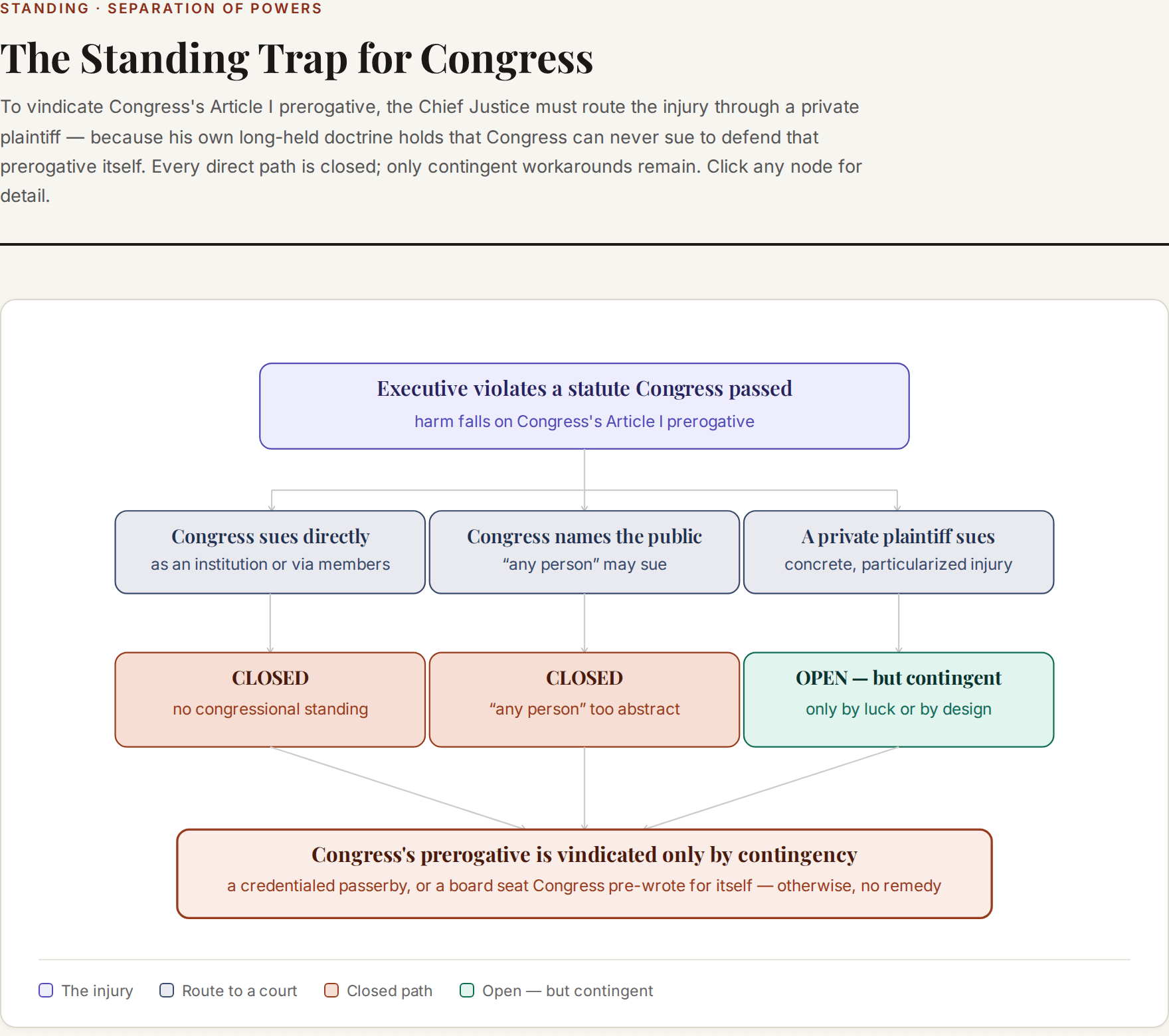
There’s some appropriations in the original bill, and a Board of Trustees. So according to the judicial precedent to which Roberts up to this point, and seemingly the current Supreme Court majority, are okay with, Congress has no real way on its own to seek redress for a clear violation of the law by the Executive Branch via the courts.
In fact it’s only because the Board of Trustees, per statute, includes a current member of Congress as an ex officio member that there’s a current operative challenge to the Executive Branch’s actions. That is, if Congress didn’t happen to establish a board for this particular purpose and appoint a Congressional member, then there wouldn’t be any nexus of harm sufficient for Congress to have standing. Congress is invisible in this case, but for a sui generis governance provision. (Or again, an architectural historian with sufficient pedigree happened to walk by).
This can’t possibly be where the balance of standing considerations leaves Article I vis-à-vis Article III, for Roberts or any of the other justices.
So Long, Take Care
In theory, theoretical injuries to Congress are merely proxies for injuries in fact to the public, or members thereof. We shouldn’t be particularly concerned about Congress’s vindication through courts of alleged injuries of rights to itself per se, only insofar as they stand in for harms to specific individuals. As long as those individuals are afforded standing under Article III’s delimitations, the Constitutional intent is intact.
One presumes, though, Congress could say explicitly who those parties are that they are intending to grant rights. Rights wherein if the Executive fails to “take care” in executing the law in question, there would be a colorable argument someone’s rights are being infringed.
So again in theory, Congress could author and pass a statute designating a person or persons as the beneficiaries of the statute. “Any person” in the case of the Endangered Species Act (1973) (“any person may commence a civil suit on his own behalf…” 16 USC 1540(g)).
According to Roberts, Congress can’t designate itself as a workaround of Article III standing’s minimal threshold, but can’t designate any person outside of Congress either (i.e., the public) (Roberts (1993), p. 1227 & nn. 52-53). In a manner of speaking, he acknowledges the ESA as drafted wouldn’t make sense to entitle a specific named person(s) with the statute’s rights, but this “any person” designation is too unspecific to be workable. And moreover can’t possibly be what Congress meant. Yes, he explicitly relies on a Congressional intent reading.
First Branch, Last in Line
Of course Congress is no ordinary party in the Constitutional order, and these interbranch disputes don’t operate in a political vacuum. Indeed it is the political situating between Article I and Article II branches that permits unique avenues of redressment unavailable to the general public.
All of which fall under the “work it out amongst yourselves” doctrine.
Again Roberts ((1993) p. 1229), but also Raines at 821; Lujan at 560; Alliance, 602 U.S. 367, 379. Lujan, 504 U.S. at 576–77 (Scalia, J.). Allen v. Wright, 468 U.S. 737, 750–52 (1984). Antonin Scalia, The Doctrine of Standing as an Essential Element of the Separation of Powers, 17 Suffolk U. L. Rev. 881 (1983). Goldwater v. Carter, 444 U.S. 996, 997–98 (1979) (Powell, J., concurring), and Trump v. Mazars, 591 U.S. 848 (2020), and elsewhere all proscribe the circumstances and mechanisms by which Congress and the President can resolve disputes without involvement of the courts.
Appropriations, oversight, passage of statutes, impeachment, and the enterprise of politics broadly, are all ways in which Congress and the President find accommodation on the numerous issues on which there is some disagreement (maybe thousands on any given day). And to presume an Article III pathway for all of them would be not only impractical but, according to the above cited authorities, inimical to the Constitution’s separating of powers.
As a prudential matter though, which of the above available mechanisms is able to address the scenario where the President obviously violates a law by renaming a thing Congress already named through statute?
Is Congress to withhold appropriations…to undo a thing it didn’t want done in the first place?
Oversight is great, but oversight is for findings of fact. What facts are in dispute? It doesn’t take Joe Historian to walk down Virginia Avenue and note the name change.
One retort offered by Isgur and French (echoing Justice Powell: interbranch disputes “should, and almost invariably do, turn on political rather than legal considerations” Goldwater v. Carter, 444 U.S. 996, 998 (1979) (Powell, J., concurring)) grants that the result may appear absurd, but if an issue doesn’t rise to the level of impeachment or other dramatic action, that’s politics at work. The issue isn’t that Congress can’t enforce proper compliance, it’s that it has to pick and choose when and where to use its various leverages. That renaming a cultural center doesn’t merit impeachment proceedings is a choice and thems the breaks.
Scalia says “take care” is the President’s obligation, and determinations of fidelity in that charge are not the court’s problem — “Carried to its logical end, [respondents’] approach would have the federal courts as virtually continuing monitors of the wisdom and soundness of Executive action” (468 U.S. at 760, quoting Laird v. Tatum, 408 U.S. 1, 15 (1972)), which the Executive does on the public’s behalf.6
But then we’re back to the standing question, not for Congress, but the public. Roberts et. al. argue it can’t be “the public,” only a person who passes what I call “the broken leg test.” An individual or specific entity with a plausible claim of specific harm.
It apparently either requires:
(a) Congress to assign itself a board seat to every statutorily authorized program (Kennedy Center case); or
(b) a non-member of Congress with sufficient expertise and interest in the subject of a program (White House ballroom case).
Congress is not permitted to assign the benefit of a law, that is I suppose, unless it does so to a specific person or group of individuals that does not contain any member of Congress. Imagine one person, John T. Plaintiff, who gets written into the end of every law, authorized as such to seek relief in court.
For that not to be the case, the President would have to initiate a wrecking ball to the Capitol Dome itself, in order for Congress to have standing to stop a construction project in lieu of a friendly nearby federal buildings expert.
A Long Walk…
Roberts has arrived at the correct outcome, if concern is over Congress’s vindication of its Constitutional prerogative, but done so through an inconsistent and untenable application of principle. The fault is not his alone, but his most recent dissent is conspicuous as a workaround of his earlier corner-painting.
Congress cannot deputize itself as a de facto private plaintiff nor is it clear the degree to which is can do so for actual private plaintiffs. It has numerous political tools at its disposal, but ought not have to be allowed to rely on subject matter experts to stand in for its claims.
National Park Service v. National Trust, 609 U.S. ___ (2026), per curiam and Roberts, C.J., dissenting; 40 U.S.C. § 8106; 3 U.S.C. § 105(d)(1)
Personally I happen to love the Second Empire styling of the Eisenhower Executive Office Building, but then again it already has its own adequate event room.
521 U.S. 811 (1997)
513 F. Supp. 265 (D. Idaho), aff’d 454 U.S. 1025 (1981)
441 U.S. 91, 100
“[A]n asserted right to have the Government act in accordance with law is not sufficient, standing alone, to confer jurisdiction on a federal court” (Allen, at 754). Effectively declaring the rule-of-law is not a cognizable interest.