

How much damage can one Representative do?
James Wallner’s new concise essay (“The Tiny Rule That Can Paralyze Congress”) breaks down the peculiarities of House pathways for partisan bills in a tight margin majority.1 I’m not much interested in politics per se, only how it constrains the policy choice set.
Which got me thinking about the bargaining dynamics of a one vote or near one-vote margin majority, and whether a model could functionally describe such a Congress in a way that tells us something about how different types of votes will unfold.2 The result is somewhat intuitive, even obvious, predictions but also some less intuitive testable claims from a closed-form normal game. And that it tracks our observed recent history is a soft indicator of plausibility.
Modeling the situation
The foundation
The literature on bargaining and specifically bargaining in a legislative structure is extensive. There are some canonical and robust foundations on which to build.
Riker’s (1962) “Minimum Winning Coalition”3 theory describes a rational proposer minimizing coalition size to maximize each member’s share of a fixed surplus.
Baron and Ferejohn (1989)4 formalizes Riker’s theoretical model and supports the MWC outcome.
Groseclose and Snyder (1996)5 offer a consistent bargaining setup except with a rival proposer which predicts competitive bidding to “buy” pivotal votes. Ultimately I do not believe this describes the current House makeup because it requires the competing coalition (in this case Democratic minority) to demonstrate a non-zero value in buying off a defector. However it is instructive for recent specific examples, one of which I witnessed first hand (more below).
The Rubinstein (1982)6 characterization is a generalizable alternating-turn bargaining game revealing that parameterizing “impatience” (cost of delay) is critical to describing an equilibrium. Again the premise, per Riker, is there is a fixed surplus from which to distribute shares, to which delays in a successful outcome (this case passing a bill) imposes differing costs on the bargaining parties and therefore affecting leverage.
Observable delay indicates incomplete/private information and information revelation models per Kennan and Wilson (1993)7 (strikes as costly signals of credible commitment).
I believe the model describes equally a situation where there is a single pivotal marginal vote or more than one (within some bound well outside the current situation) because it does not rely on sole holdup power as a sufficient condition to establish bargaining leverage. Shapley and Shubik8, Banzhaf9, and Owen10 are canonical contributions supporting legislative bargaining as not a purely individual, but effectively coalitional blocs game.
Structural elements from the above inform the model.
The Model: Narrative Description
The players
In this model we imagine “leadership” is the proposer, with the implicit ability to set the agenda by limiting floor consideration of other legislation. Negotiating with leadership is a “faction” of holdouts. The faction isn’t a unified or otherwise coordinated bloc (though it can be). It is collectively the undetermined number of individual members, each unrestricted to have their own preferences. But we can include them singularly in one vector without loss of generality.11
The bill
They’re bargaining over the outcome of a single bill with a range of policy outcomes. At one end is leadership’s ideal outcome, and at the other is the holdout’s. Because the collective faction is a heterogeneous set of individual holdouts, the policy range is an index that allows the variable to represent the preferred outcome for that member specifically.
Accordingly, a holdout’s ideal is at one end of the outcome range, but there is some point below that sufficient for an agreement because holdout is not costless (“constraints”).
The constraints
Both leadership and holdouts bear some cost from delay, individuated for the holdouts. The latter’s cost is tied to electoral risk: for example a super-safe district, high reelection expectation, means the member can bear more delay at less cost. Leadership may bear more of the cost of missing a debt limit deadline, forcing a government shutdown, or inability to get on to other substantive priorities, because they bear a broader caucus-wide electoral incentive to show a functioning majority.
They also of course bear some cost in moving from their preferred policy outcome toward a holdout’s. Also more time goes by, there’s an underlying increase in the likelihood of breakdown and no one gets anything.
The Model: Formal Description
Players
F is the set of pivotal holdout members — members who can’t be substituted for alternative bargainers. Each individual holdout is indexed i. Membership in Fi is established beforehand. Leadership (L) acts as the sole proposer.
Variables:
x — the policy outcome, running from 0 (leadership’s baseline bill, no concessions) to 1 (a fully-conceded bill matching a holdout’s ideal).
ui(x) — holdout i‘s payoff from the bill passing at concession level x; utility increasing in x.
ci(t) — holdout i‘s own cost of delay, as a function of time t remaining before the deadline. A safe-seat member has a low, close-to-flat ci(t); a vulnerable-seat member has a steep one.
di — the disagreement point: what member i gets if bargaining collapses entirely and no deal is reached.
cL(x) — leadership’s cost of granting concession x; increasing in x.
cL(t) — leadership’s own cost of delay; convexly increasing in t.
π(t) — the probability, at time t, bargaining collapses to the disagreement point rather than resolving at baseline.
xi* — holdout i‘s equilibrium reservation demand: the minimum concession they’ll accept.

The holdout equation says member i accepts a given offer only if the payoff from that offer, net of current delay, is at least as good as their risk-weighted expected payoff from walking away.
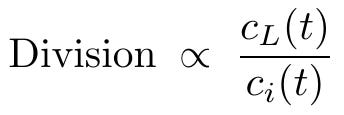
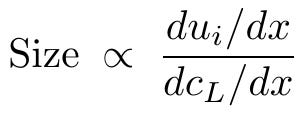
Division vs. size are two separate levers.
Division is governed by the ratio of leadership’s cost of delay to the holdout’s own — the more impatient leadership is relative to the holdout, the more of the available concession goes to the holdout.
Size is governed by the ratio of how much the holdout values a unit of concession relative to how much it costs leadership to grant it. A concession can be cheap for leadership and valuable to the holdout.

The budget constraint is the vote-counting condition: n is the number of GOP holdouts casting an outright “no”, p is the number “present” or “absent,” m is the raw seat margin (R − D). A “no” costs the coalition two points of margin, a “present/absent” costs one, and leadership’s total tolerance is the margin minus one.

Comparative statics (testable directional claims):
leadership’s rising cost of delay near a deadline increases level of concession.
a holdout’s own rising cost of delay decreases what they extract.
a more favorable ratio of the holdout’s valuation to leadership’s cost of granting it (i.e., more divisibility) increases what they extract, independent of patience.
Payoff Matrix
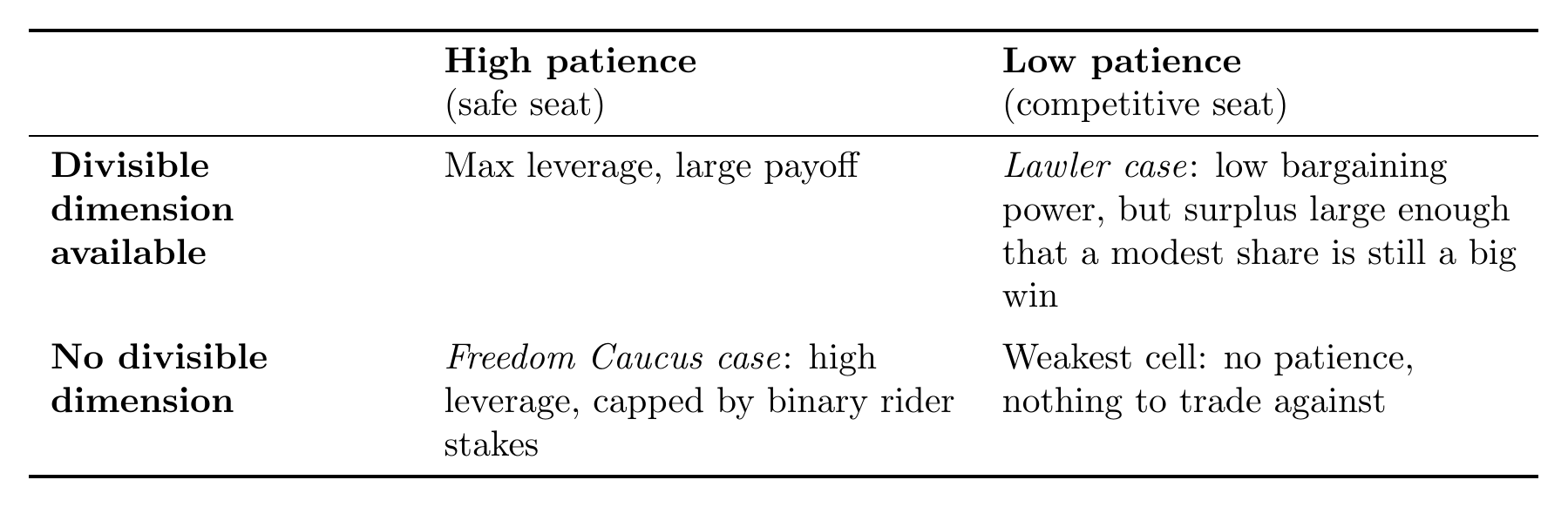
“Lawler case” refers to Rep. Lawler’s demands nearing passage of the 2025 tax bill (OBBBA). In contrast to Rep. Luna, he is in arguably the most competitive district in the country which makes the implied cost of blowing up the bill incredibly high. But in our model a comprehensive tax bill is highly “divisible” and offered a large payoff (SALT deduction) if he is successful (which he was).
Conclusion
Okay so most of that you could draw from intuition, not exactly pathbreaking. But here’s a couple implications that are perhaps not so obvious:
News reporting tends to focus on the naive partisan margin at any given time as shorthand for the bargaining dynamics. In a sense that tells you who is “in the room” as a candidate for being pivotal vote but it is incomplete. Two (or more) members can be equally likely to be pivotal (“pivotality” in the literature) but get widely different results.
It is determined by:
cost of delay (idiosyncratic to the member)
divisibility (a characteristic of the bill itself)
ratio of cost of concession (leadership) to value of concession (holdout)
Leadership cost of delay non-linearly increasing (convexity) - this is an assumption built in to the model
High drama like shutdowns and extended speakership ballots are the result of imperfect information, a means of information revelation. In earlier times of old-fashioned logrolling, leadership already has a good idea of how much it costs to “buy” a member’s vote.
Predictions
NDAA/SAVE Act: House leadership offered Rep. Luna a package as a single vote, but still remain textually separable. This was the “cheaper” offer which she rejected. She has now signaled credible resolve by bearing real cost and has a safe seat. The model prediction is that we’ll end up with something resembling her ask: the bills are actually linked into the same text to be voted on (NDAA+SAVE). Doesn’t guarantee Senate can’t undo it but they do now bear a higher cost of doing so.
Appropriations/shutdowns: less clean and fairly familiar. Concessions will cluster in the final 24-72 hours before deadlines.
FISA: because as I understand it much of the FISC certifications effectively run through March 2027, we haven’t approached the meaningful deadline which is why we didn’t see much bargaining/concession - leadership’s cost function never reached the spiking point. We’ll see that happen in the Spring.
Potential Empirical Testing & Extensions
Empirical
Input Cook PVI scores to specify the electoral risk parameter (which inputs to delay cost). Compare predicted level of concessions with actual ones for sample of major bill fights.
The literature has multiple methodologies for computing a “power index” by tabulating across conceivable winning coalitions, based on voting pattern, what is a given member’s pivotality. The model then provides a testable prediction going forward.
Extensions
Like James points out the unfolding of coalitions and bargaining is not fully instrumented by votes, but all the procedural maneuvering and minutiae strategically deployed leading up to a vote (or preventing altogether). This accounts for none of that. Could be possible to introduce some elements as an additional leadership lever.
d is what a holdout gets in a no-deal scenario, but it’s exogenous right now. Possibly it can be derived endogenously from an election subgame.
Policy space exists across a one-dimensional scalar x. Of course not always the case so could be made multi-dimensional but increases complexity considerably.
This represents a one-shot normal form game. In a repeated game you can include carryover effects which feed equilibrium strategy, like credibility or reputation.
[Kevin R. Kosar maybe you have thoughts]
James is arguably the leading expert on the deeply granular details of Congressional procedure and the political constraints driving their use.
Strictly speaking at the time of this writing, the explicit partisan makeup is 218-212 (R-D) with one Independent generally caucuses with the majority and four vacancies (1-4), affording three defections from the GOP before failure. But absences at various times makes the exact number at the time of vote fluid. For purposes here I’m assuming a faction of holdouts, not necessarily organized or seeking the same thing, but small enough to preclude competing coalitions to weaken their positions. I believe we do not lose generality but treating this non-uniform as a matrix vector.
Riker (1962), The Theory of Political Coalitions.
Baron & Ferejohn (1989), “Bargaining in Legislatures,” APSR 83(4), 1181–1206.
Groseclose & Snyder (1996), “Buying Supermajorities,” APSR 90(2), 303–315.
Rubinstein (1982), “Perfect Equilibrium in a Bargaining Model,” Econometrica 50(1), 97–109.
Kennan & Wilson (1993), “Bargaining with Private Information,” Journal of Economic Literature 31(1), 45–104.
Shapley, L. S., & Shubik, M. (1954). “A Method for Evaluating the Distribution of Power in a Committee System.” American Political Science Review, 48(3), 787–792.
Banzhaf, J. F. (1965). “Weighted Voting Doesn’t Work: A Mathematical Analysis.” Rutgers Law Review, 19(2), 317–343.
Owen, G. (1977). “Values of Games with a Priori Unions.” In R. Henn & O. Moeschlin (eds.), Mathematical Economics and Game Theory. Springer, 76–88.
Similarly leadership L could be made up of component members (li within L) but it doesn’t change the result.